CROCODILE- Nifty Trading System
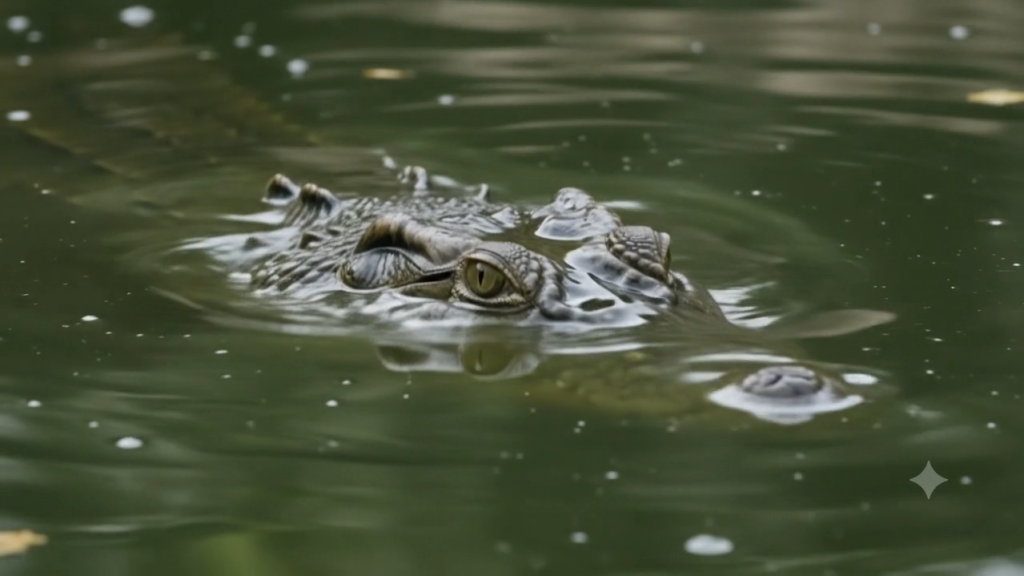
Patience. Discipline. Speed.
The Three Words That Define the CROCODILE Nifty Trading System
The philosophy of the CROCODILE Nifty Trading System can be summarized in three words:
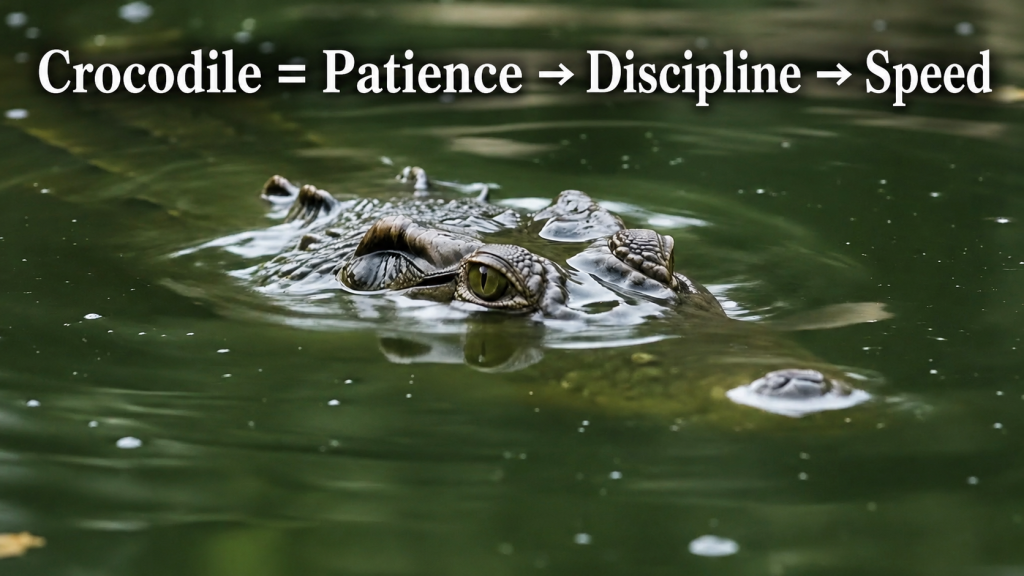
Patience → Discipline → Speed
These three words were not chosen for marketing.
They came from studying the real crocodile.
The CROCODILE Nifty Trading System was designed after carefully examining the behavioral characteristics that have allowed crocodilians to remain formidable apex predators across an extraordinary span of evolutionary history.
A creature does not survive across millions of years by behaving randomly. It survives because certain characteristics are exceptionally well suited to its environment.
The crocodile has found a remarkably effective operating model:
It does not waste energy unnecessarily.
It does not chase everything that moves.
It understands distance.
It understands its own strengths.
It understands where it is vulnerable.
It waits.
It calculates.
It stays hidden.
And when the conditions finally become favorable, the transformation is extraordinary.
The apparently motionless animal suddenly becomes explosively fast.
That combination inspired the design philosophy behind CROCODILE.
As the creator of the system, I studied crocodile behavior extensively and also consulted marine biology expertise while thinking about how these same characteristics could be applied to trading.
Eventually, everything distilled into three words:
Patience. Discipline. Speed.
Each one has a very specific meaning.
And together, they explain how CROCODILE thinks about the NIFTY market.
1. PATIENCE
Patience is the first principle because everything else depends upon it.
A crocodile can remain almost completely invisible in the water for long periods.
It may be only a short distance from the shoreline.
It may already be watching potential prey.
Yet it does nothing.
There is no requirement to move.
There is no requirement to attack.
There is certainly no requirement to prove that it is active.
It remains submerged.
That is stealth mode.
And this is precisely how CROCODILE behaves in the NIFTY market.
The CROCODILE Does Not Need a Trade
Most retail trading systems appear to begin with an assumption:
The trader needs to trade.
There must therefore be a signal.
Today.
Tomorrow.
This week.
Something must happen.
CROCODILE starts from the opposite assumption.
There is no reason to trade unless the market presents an opportunity worth risking capital for.
The default state of CROCODILE is therefore not:
BUY.
It is not:
SELL.
It is:
STAY UNDERWATER.
No action.
No unnecessary exposure.
No trade simply because the market is open.
The 200-Point Question
CROCODILE’s patience is expressed through its most important market requirement.
Before considering a trade, the system asks:
Is there a good probability that NIFTY will move at least 200 points in a particular direction within approximately the next 48 hours?
If the answer is not strong enough, CROCODILE does not reveal itself.
It stays underwater.
This is critical.
CROCODILE is not interested merely because NIFTY may move 50 points.
It is not interested because an indicator flashed bullish.
It is not interested because there has been an intraday breakout.
It is looking for a movement large enough and fast enough to justify taking risk.
For weekly options particularly, this matters enormously.
Options are under time pressure.
A trader can be correct about direction and still fail if the market takes too long to move.
Therefore CROCODILE requires movement with magnitude and urgency.
Approximately 200 points.
Approximately 48 hours.
Without that, patience wins.
The Crocodile Conserves Energy
This behavior has a biological parallel.
A real crocodile cannot afford to spend enormous amounts of energy chasing every possible meal.
A low-probability pursuit is expensive.
Every unsuccessful attack consumes energy.
It can also expose the crocodile unnecessarily.
So the animal waits until the geometry, distance, timing, and behavior of its target improve the probability of success.
That is exactly what CROCODILE does with capital.
For a trader, capital is energy.
Every mediocre trade spends some of that energy.
Commissions matter.
Slippage matters.
Losses matter.
Mental fatigue matters.
Repeated decision-making matters.
And perhaps most importantly, a trader who wastes capital on weak trades may not have the confidence or financial capacity to act aggressively enough when the truly exceptional opportunity appears.
Therefore:
CROCODILE conserves capital in the same way that the real crocodile conserves energy.
Patience is capital conservation.
Revealing Yourself Creates Risk
There is another important lesson from the real animal.
A crocodile is extraordinarily powerful in water.
Water is its domain.
Its body, movement, concealment, and attack strategy are suited to that environment.
Once it leaves that environment, however, its risk changes.
Coming onto land exposes the crocodile.
It therefore does not remain there unnecessarily.
Trading has an equivalent.
When CROCODILE has no open position, it is underwater.
Protected.
Watching.
Analyzing.
Waiting.
The moment it enters a trade, it has revealed itself.
Capital is now exposed.
The market can move against it.
Time can work against it.
The thesis can fail.
In an options position, theta begins to matter continuously.
Therefore opening a position should never be treated casually.
Entering the trade is equivalent to the crocodile leaving the protection of the water.
There must be a sufficiently compelling reason.
Great Traders Have Always Understood Patience
This idea is not unique to CROCODILE.
Many legendary traders and investors have emphasized patience in different forms.
The language varies.
The instruments vary.
The time horizons vary.
But the underlying principle remains remarkably similar:
You do not need to participate in every opportunity.
Jesse Livermore famously built much of his trading philosophy around waiting for the larger move rather than constantly jumping in and out of markets.
Long-term investors such as Warren Buffett and Charlie Munger built a very different style of investing, yet patience again sits at the center.
Their time horizons may be measured in years rather than hours.
CROCODILE may be hunting a 48-hour NIFTY move.
But the underlying behavioral discipline is remarkably similar:
Wait until the odds appear favorable enough.
The timeframe changes.
Patience does not.
CROCODILE PATIENCE
We can therefore define CROCODILE patience very simply:
Do nothing until there is a good reason to do something.
And in practical NIFTY trading:
No high-probability 200-point move in 48 hours = stay underwater.
That is the first word.
2. DISCIPLINE
Patience tells the CROCODILE when not to act.
Discipline tells it how to act when an opportunity begins to appear.
Discipline is often misunderstood as simply following rules.
It is deeper than that.
For CROCODILE:
Discipline means respecting reality.
Respect your environment.
Respect your limitations.
Respect distance.
Respect timing.
Respect risk.
Respect the capabilities of the opponent.
And respect the fact that the market does not owe you anything.
A Crocodile Understands Distance
Watch a crocodile hunting near the edge of water.
It does not attack prey that is arbitrarily far away.
Distance matters.
The farther the target moves from the crocodile’s effective strike zone, the lower the probability of a successful attack.
At some point, pursuing the target becomes irrational.
The crocodile understands this instinctively.
CROCODILE trading incorporates the same idea.
This is one reason behind the 1% Distance Rule for NIFTY options.
Suppose NIFTY is trading near 25,000.
One percent represents approximately 250 points.
The CROCODILE does not want an options trader buying strikes vastly farther away merely because they appear cheap.
For Calls, the strike should remain reasonably close above spot.
For Puts, reasonably close below spot.
The option must remain within the effective strike zone of the expected NIFTY movement.
That is not coincidence.
It is the trading equivalent of the crocodile understanding how far it can effectively strike.
Distance Changes Probability
This principle is easy to understand outside financial markets.
Suppose a crocodile has prey standing one meter from the water.
Now imagine the same prey twenty meters away.
It is still the same prey.
The crocodile is still the same animal.
But the probability of success is completely different.
Distance changed the trade.
Options behave similarly.
Suppose CROCODILE correctly forecasts a 200-point NIFTY rise.
If the trader purchases an appropriately selected Call reasonably close to spot, that 200-point move may produce a meaningful response.
But if the trader buys an extremely distant OTM Call because it costs only a few rupees, the same correct directional forecast may produce a poor result.
The market call was right.
The instrument selection was wrong.
Hence:
Distance is not a minor technical detail. Distance is part of probability.
And probability is what CROCODILE cares about.
Discipline Means Understanding Yourself
A real crocodile does not attempt to become a cheetah.
It does not attempt to chase animals across enormous stretches of open land.
That is not its strength.
It understands what it is.
That same principle matters enormously in trading.
A trader must understand:
How much capital do I have?
How much can I afford to risk?
What instrument am I trading?
What are the limitations of that instrument?
How much time does the trade have?
What happens if the market does not move immediately?
What happens if I am wrong?
This is why CROCODILE has strict risk and position-size requirements.
Discipline begins with:
Know what you can afford to lose before thinking about what you might make.
Discipline Also Means Understanding the Opponent
And this brings us to one of the most important educational ideas in the entire CROCODILE philosophy.
When somebody buys real estate, one of the first questions they often ask is:
Why is the seller selling?
It is a perfectly logical question.
Why does the current owner want to exit?
Is there something wrong with the property?
Does the seller urgently need cash?
Has the neighborhood changed?
Is there information I should understand?
Yet something strange happens in options markets.
A trader sees:
NIFTY Call: ₹60
And thinks:
“I can buy it for ₹60.”
But rarely asks:
Why is somebody willing to sell this option to me for ₹60?
That question should be fundamental.
There is a seller on the other side.
That seller may believe the probability of the option producing a sufficiently large payoff is low.
The seller may be hedged.
The seller may have a portfolio structure the retail trader cannot see.
The seller may understand the behavior of time decay very well.
The seller may simply believe ₹60 is attractive compensation for the risk being assumed.
Whatever the reason, the buyer should ask the question.
Why is the seller selling?
That one question transforms options trading from passive consumption into adversarial analysis.
The Seller Is Not Giving You a Gift
Retail option buyers sometimes treat the premium almost like a store price.
₹40.
₹60.
₹100.
They simply decide whether it looks affordable.
But financial markets do not work like supermarkets.
The seller is not putting the option on sale because they want you to have a bargain.
There is an opposing economic view behind the trade.
Understanding that reality produces discipline.
If an option is extremely cheap, ask:
Why?
If nobody appears interested in the Put after a huge bullish NIFTY session, ask:
Why?
If Call premiums have collapsed after a violent selloff, ask:
Why?
And then ask the more interesting CROCODILE question:
Has the market become too comfortable with the current direction?
Now we are moving from price observation to market intelligence.
Discipline Means Respecting the Environment
The market environment changes continuously.
Volatility changes.
Liquidity changes.
Expiry approaches.
Political events happen.
Global markets move.
Institutional positioning changes.
A rule that makes sense under one environment can behave differently under another.
That is why discipline does not mean blindly doing the same thing every day.
It means operating within a defined framework while respecting current conditions.
The real crocodile survives because it is extraordinarily well adapted to its environment.
The trading CROCODILE must do the same.
The 200-Point Rule Is Also Discipline
The 200-points-in-48-hours requirement is usually associated with patience.
But it is also discipline.
Because once you have established the rule, you must refuse to weaken it merely because you are bored.
Suppose CROCODILE sees only a likely 80-point move.
The trader may be tempted:
“Eighty points is still something.”
Perhaps.
But that is no longer the CROCODILE trade.
The discipline is:
Respect the minimum movement requirement.
Likewise with strike distance.
Likewise with expiry.
Likewise with position size.
Discipline means that a rule does not become optional simply because a trader wants action.
CROCODILE DISCIPLINE
So the second word can be summarized as:
Understand your environment, understand your opponent, understand your limitations, and respect the strike zone.
That is discipline.
3. SPEED
And then something changes.
The crocodile that has been nearly motionless suddenly strikes.
Anyone who has watched real crocodile footage understands how dramatic the transformation can be.
The same animal that appeared slow and passive can generate extraordinary speed during the attack.
Why?
Because the decision phase is over.
The crocodile has already waited.
It has already evaluated distance.
It has already watched the target.
It has already conserved energy.
It has already determined that the opportunity is worth taking.
At that point:
More waiting is no longer patience.
It becomes hesitation.
And hesitation can destroy the opportunity.
Patience and Speed Are Not Opposites
This is one of the most important CROCODILE lessons.
People sometimes confuse patience with slowness.
They are completely different.
CROCODILE may wait for days before taking a position.
But once the conditions align, the execution should be fast.
Therefore:
The CROCODILE waits slowly and acts quickly.
That is the correct combination.
A trader who acts quickly without patience becomes impulsive.
A trader who waits patiently but cannot act decisively becomes ineffective.
The CROCODILE requires both.
Speed Means Decisive Entry
Suppose CROCODILE identifies the high-probability setup.
The 200-point potential exists.
The direction has been determined.
The selected option meets the distance requirement.
Enough time remains before expiry.
Position size complies with risk rules.
At this stage, endless reconsideration becomes harmful.
Should I enter now?
Maybe I will wait another 15 minutes.
Maybe another candle.
Maybe tomorrow.
Perhaps the premium will fall another ₹5.
This is exactly where a trader can miss the opportunity that required several days of patience to find.
Once the decision framework has been satisfied:
Execute.
That is speed.
Speed Also Means Fast Exit
This may be even more important.
Retail traders frequently understand speed at entry but completely forget it at exit.
They buy an option.
The option rises.
Their target is reached.
And suddenly discipline disappears.
They begin negotiating with themselves.
Maybe it will rise another 20%.
Maybe tomorrow will be even better.
Maybe NIFTY will keep going.
Maybe this is the big one.
CROCODILE rejects this behavior.
If the target was defined before entry, the exit should already be planned.
Suppose an option is bought at:
₹60
And the predefined profit objective is:
50%.
The exit level is therefore:
₹90.
The CROCODILE approach is not:
“When it reaches ₹90, I will start thinking about whether to sell.”
The CROCODILE approach is:
If ₹90 is the target, the sell order belongs at ₹90.
When the market reaches the target:
Exit.
No debate.
No greed.
No improvisation.
The Crocodile Does Not Remain on Land
This gives us one of the most powerful metaphors in the entire system.
When the real crocodile leaves the water to seize prey, it does not linger unnecessarily on land.
Its objective is to complete the strike and return to its strongest environment.
An NIFTY option position should be viewed similarly.
When CROCODILE is holding an option:
The crocodile is on land.
The trade is exposed.
Time is passing.
Theta is working.
The market can reverse.
A paper profit can disappear.
The longer the trader stays unnecessarily, the longer the exposure continues.
So CROCODILE’s objective is not merely:
Enter fast.
It is:
Enter fast. Achieve the objective. Exit fast.
Then:
Return underwater.
That is a complete CROCODILE cycle.
The Trade Is Not Your Home
This concept deserves emphasis.
Retail traders often become emotionally attached to positions.
They begin treating a profitable option as though it belongs to them.
They want to see how far it can go.
But a trade is not a possession.
It is temporary risk exposure.
CROCODILE understands this.
The option is not home.
The water is home.
Being flat is home.
Watching without exposure is home.
Holding a position is a temporary expedition outside the safety of the water.
That mental model changes everything.
Speed Prevents Greed From Taking Control
Predefined exits are also valuable because they prevent emotion from entering at the most dangerous moment.
Before the trade:
You are rational.
You can calculate.
You can define the target.
After the trade moves strongly in your favor:
Emotion rises.
Greed becomes stronger.
Confidence increases.
The mind begins projecting.
“Maybe this will double.”
“Maybe I should hold.”
“Maybe this is an exceptional trade.”
That is precisely why the target should be determined before the market gives you a reason to become emotional.
If the objective is 50%, define 50%.
If the trade reaches it:
Exit.
The system decided when the trader was calm.
Do not allow excitement to overrule the system afterward.
The Complete CROCODILE Sequence
Now the three words fit together perfectly.
PATIENCE
Stay underwater.
Observe.
Conserve capital.
Wait for a high-probability opportunity.
Require meaningful movement potential.
Do not reveal yourself unnecessarily.
DISCIPLINE
Understand your environment.
Understand your limitations.
Understand distance.
Understand your opponent.
Respect position sizing.
Respect the 200-point requirement.
Respect the 1% strike distance.
Respect expiry.
Ask:
Why is the seller selling?
SPEED
Once everything aligns:
Strike decisively.
Enter without unnecessary hesitation.
Use predetermined targets.
Exit immediately when the objective is achieved.
Return underwater.
Patience Without Discipline Is Just Waiting
There is another important point. The three qualities only become powerful when they operate together.
Patience alone is insufficient. A trader could wait for five days and then buy an absurdly distant OTM option. The waiting achieved nothing.
Discipline is required to structure the trade properly. Likewise: Discipline without patience can produce perfectly structured mediocre trades.
The position size may be correct. The strike may be correct. The expiry may be correct. But if there was no sufficiently powerful NIFTY setup, the trade should never have existed.
And patience plus discipline without speed can result in missed opportunities or profits being returned to the market.
Therefore the sequence matters:
Patience → Discipline → Speed
Not one. All three.
Why the Order Cannot Be Reversed
Imagine the philosophy backward:
Speed → Discipline → Patience.
That describes a large amount of unsuccessful retail options trading.
First: Act quickly. Buy because something moved.
Then: Try to figure out risk.
And finally: Become patient with the losing position.
That is exactly the wrong kind of patience. A trader enters impulsively and then becomes extraordinarily patient while the option loses value.
The CROCODILE does the opposite.
Be patient before entry.
Be disciplined during selection.
Be fast after the decision.
That one reversal of behavior can radically change the quality of trading.
The Fish Behaves Differently
This is also where the broader CROCODILE philosophy becomes relevant.
Professional Nifty Option Sellers see uninformed Retail Option Buyers as fish entering their nets.
The fish cannot defeat the net by swimming faster.
They need to stop behaving like fish.
They need to think like the CROCODILE. Because the CROCODILE sees those Nifty Option Sellers as the target.
Stop Trading Like the Fish. Trade Like the Crocodile.
The fish is reactive. The fish sees movement and follows.
The CROCODILE waits patiently before any movement.
The fish thinks cheap means attractive.
The CROCODILE asks why the seller is willing to sell cheaply.
The fish buys distant strikes hoping for magic.
The CROCODILE respects strike distance.
The fish holds because greed says there might be more.
The CROCODILE exits when its objective is complete.
The behavioral difference is fundamental.
Why Ask: “Why Is the Seller Selling?”
Of all the questions in this post, this may be the one every retail options trader should remember.
You are about to buy an NIFTY Call for ₹60.
Before clicking BUY, ask:
Why is the seller willing to sell this option for ₹60?
You may still buy it. The CROCODILE is not saying the seller is always correct. In fact, the CROCODILE specifically hunts situations where Nifty Option Sellers may have become too comfortable.
But the question forces you to think.
Perhaps the seller believes the strike is too far away.
Perhaps expiry is approaching.
Perhaps implied volatility is favorable to them.
Perhaps they expect NIFTY to remain within a range.
Perhaps their position is hedged.
Now the buyer has to ask:
What do I know—or what does my system see—that makes this trade attractive despite the seller’s willingness to take the other side?
That is intelligent options trading.
The CROCODILE Wants Complacent Sellers
This connects directly with CROCODILE’s reversal strategy.
Suppose NIFTY has just rallied violently.
Put premiums have collapsed.
Sellers may feel increasingly comfortable.
The market believes downside probability has diminished.
But CROCODILE sees a high-probability daily reversal forming.
Now the important question:
“Why is the seller selling this Put option cheaply?”
has an answer.
Because the seller believes the prevailing bullish move will continue or that NIFTY will not fall sufficiently before expiry.
But the CROCODILE has a different assessment.
If CROCODILE’s reversal thesis is correct, the seller’s comfort or complacence becomes the buyer’s opportunity. That is exactly the kind of situation the CROCODILE wants.
But even then: Patience first. Discipline second. Speed third.
A Crocodile Does Not Win Through Constant Fighting
Perhaps this is the deepest lesson from the real Crocodile itself.
The crocodile’s status as an apex predator does not come from attacking continuously. It comes from being exceptionally selective about when and how it attacks.
That is a profound lesson for traders. The greatest strength of a trading system may not be how many opportunities it finds.
It may be how many bad opportunities it rejects.
The CROCODILE’s silence is part of its intelligence.
Its restraint is part of its power.
Its patience creates the conditions for discipline.
Its discipline creates the conditions for decisiveness.
And decisiveness produces speed.
The CROCODILE Operating Cycle
The complete cycle can therefore be expressed very simply.
1. SUBMERGE
No qualifying opportunity? Stay underwater.
2. WATCH
Analyze Nifty50 index. Study direction and patterns.
Study reversal probabilities. Look for a potential 200-point move.
3. MEASURE
Is the target within striking distance?
Does the option satisfy the 1% rule?
Is enough time available?
Does the position size satisfy risk limits?
4. UNDERSTAND THE OTHER SIDE
Why is the option seller willing to sell?
What is the market currently expecting?
Where may complacency exist?
5. STRIKE
When the probability and structure align: Enter decisively.
6. EXIT
When the predefined objective is reached: Take the profit.
Do not renegotiate with greed.
7. RETURN TO WATER
Close the exposure. Return to stealth mode.
Wait for the next legitimate opportunity.
That is the CROCODILE.
That is the winner.
Patience Is the Foundation
Discipline Is the Structure
Speed Is the Execution
There is perhaps no better way to summarize the system.
Patience prevents unnecessary trades.
Discipline prevents bad trades.
Speed prevents good trades from becoming bad trades.
And all three protect capital. That is why:
Patience → Discipline → Speed
is not merely the CROCODILE slogan.
It is the CROCODILE operating system.
Final Thought: Become the Crocodile that the System Was Designed Around
Millions of years of survival teach an important lesson.
Nature rewards behavior that fits the environment.
The crocodile does not survive because it is the fastest creature. It does not survive because it attacks continuously.
It survives because it knows when to remain invisible, how close the opportunity must come, when to commit, and when to return to safety.
That is precisely what CROCODILE asks of the trader.
Wait. Measure. Understand. Strike. Exit. Disappear again.
Patience while waiting.
Discipline while selecting.
Speed while executing.
That is the CROCODILE philosophy.
That is how the system was designed.
And that is how a CROCODILE trader must learn to think.
CROCODILE- Nifty Trading System
Patience → Discipline → Speed
Stay underwater until the probability is worth revealing yourself.
Respect the strike zone.
When the opportunity arrives, strike—and return to safety.
Stop Trading Like the Fish. Trade Like the Crocodile.
This is one of the most important CROCODILE posts because it explains that the three words (Patience, Discipline, Speed) are not marketing slogans placed on top of a trading system. They are the behavioral architecture of the system itself and part of the DNA of the CROCODILE system.
Disclaimer: Nifty Futures and Options involve substantial risk of loss. Options buyers can lose 100% of the premium paid, while leveraged Futures positions may create substantial losses. Illustrative prices and profit targets in this article are examples of CROCODILE process and do not constitute promises of returns. Trading setups are probabilistic and can fail. The CROCODILE (NiftyOptionsTrading .in) provides market research and trader education, and does not provide personalized investment advice. We have zero visibility into the trading accounts of our subscribers.