This is a powerful CROCODILE lesson because it corrects one of the most common mistakes in trading: confusing Activity with Engagement.

We Must Be Engaged to Engage
The CROCODILE Lesson for NIFTY Options Traders
One of the most important lessons I learned during military boot camp can be expressed in a very simple sentence:
We must be engaged to engage.
That principle applies remarkably well to NIFTY options trading.
As an option buyer, eventually we may engage an option seller.
We may buy a Call. We may buy a Put.
But the actual transaction is only the final stage of engagement.
Long before the trade is placed, the trader should already be engaged.
Watching. Thinking. Analyzing. Questioning.
Comparing probabilities. Understanding the environment.
Studying the other side. Waiting for favorable terms.
And remaining completely prepared to act when those terms finally appear. That is what CROCODILE trading means by:
We must be engaged to engage.
Engagement Does Not Mean Trading
This distinction is fundamental.
Many retail traders unconsciously define engagement like this:
If I have a position, I am engaged.
And therefore:
If I do not have a position, I am inactive.
CROCODILE rejects that definition completely.
A trader can be completely flat and yet intensely engaged with the market. In fact, some of the most important work happens while no trade exists.
The CROCODILE may be underwater.
Invisible. Silent. Apparently inactive. But it is not disengaged.
It is observing. And observation is part of engagement.
Inactivity Is Not Inattention
Imagine a crocodile submerged near the edge of the water.
Nothing appears to be happening. The Crocodile is not swimming.
It is not chasing. It is not announcing its presence.
From the outside, somebody may conclude:
“The crocodile isn’t doing anything.”
That is the wrong conclusion.
The crocodile is available for action.
Its attention remains connected to its environment.
If an appropriate target suddenly enters its effective strike zone, the transition from stillness to action can happen extremely quickly.
That teaches us something important about trading:
Stillness and readiness can exist at the same time.
CROCODILE inactivity is therefore not sleep.
It is prepared observation.
The Highest Form of Engagement May Look Like Doing Nothing
Retail traders frequently feel pressure to prove that they are participating.
The market opens. Prices start moving. Candles appear.
News comes in. Other traders begin posting positions.
And suddenly doing nothing feels uncomfortable.
But CROCODILE sees the problem differently. There are periods when doing nothing while observing closely is the highest-quality decision available.
Why? Because the system has not yet found terms worth accepting.
The market is offering trades continuously.
But CROCODILE has no obligation to accept them.
That is one of the greatest advantages an option buyer possesses.
You can choose when to engage.
You do not have to trade because a price exists.
You do not have to buy because somebody is offering an option.
You do not have to participate because other traders are participating. You can wait.
The Option Seller Is Always There
Open an NIFTY option chain and you will see prices continuously.
Calls are quoted.
Puts are quoted.
Different strikes are available.
Different expiries are available.
The market is constantly presenting terms.
In effect, the option seller is continuously saying:
“Here is the price at which I am willing to sell this risk to you.”
Suppose a Put is offered at ₹70.
The inexperienced trader asks:
“Can this ₹70 option become ₹100?”
CROCODILE asks something earlier:
“Why is somebody willing to sell this option to me at ₹70?”
That question is part of engagement.
Before entering into a transaction, understand the other side.
We Are Not Forced to Engage
This is an enormous advantage.
Before entering a position, an option buyer has freedom.
The buyer can say: No. Not now. Too expensive. Too close to expiry.
Too far from spot. Insufficient movement potential.
Wrong market environment. Weak probability.
No reversal setup. No 200-point opportunity.
And simply walk away. That freedom is valuable.
But once the buyer enters the trade, the situation changes.
Now capital is exposed. Time starts passing. The option will face time decay. The market can move against the position. An exit will eventually be required.
The buyer has moved from optional engagement into actual exposure.
Therefore:
The best time to be demanding is before the trade exists.
Before engagement, you have maximum freedom.
After engagement, you have obligations.
That is why the terms of engagement matter so much.
Do Not Engage Until the Terms Favor You
This is one of the central CROCODILE principles.
The option seller may always be willing to transact.
But CROCODILE does not engage just because the seller is present.
The CROCODILE waits until the conditions become favorable.
That could mean:
A sufficiently strong directional NIFTY setup.
A high-probability reversal developing.
A meaningful 200-point movement opportunity.
A suitable strike within the CROCODILE distance requirement.
Enough time before expiry.
A premium that has not already exploded.
A position size that fits the capital-protection framework.
Only when multiple conditions align does engagement become attractive.
In other words:
The Option Seller chooses the option price being offered.
The CROCODILE chooses whether the engagement happens at all.
That choice is powerful.
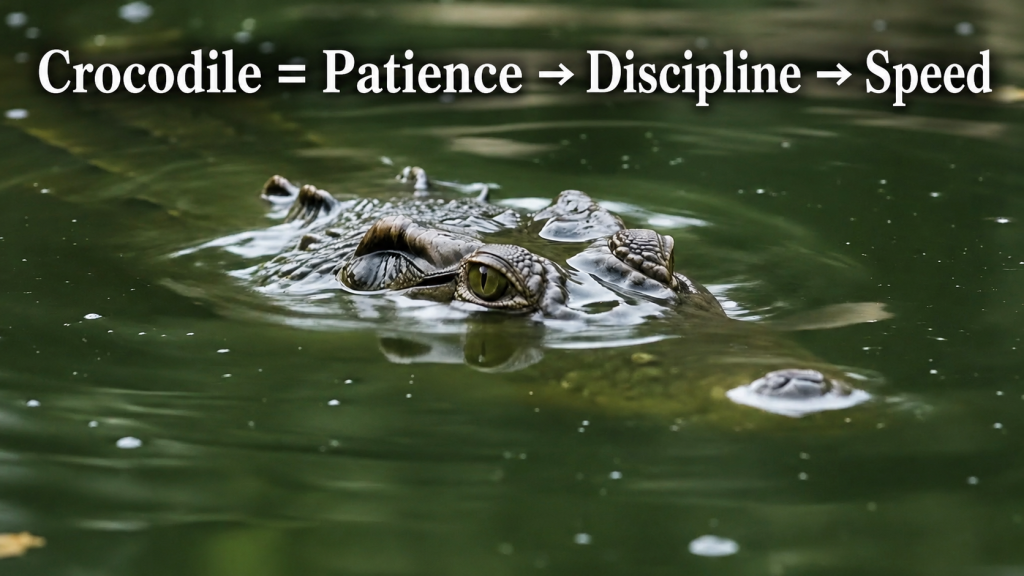
Patience Is Engagement
This connects directly to the first word of the CROCODILE philosophy:
Patience
Patience does not mean mentally leaving the market. It does not mean forgetting the market exists. It means staying actively connected while refusing to act prematurely.
The CROCODILE can watch a setup develop for hours or days.
Perhaps NIFTY is approaching an important reversal structure.
But it is not ready. Perhaps global markets are unstable.
Perhaps option premiums remain too expensive. Perhaps NIFTY has not yet reached the conditions required for the 200-point move.
The CROCODILE watches. No trade. But full engagement.
Discipline Is Engagement
The second word is:
Discipline
Discipline means continuing to evaluate the environment even when temptation appears.
Suppose a Call suddenly starts rising.
Everybody can see it. The trader feels FOMO.
But the strike is too far away. Or expiry is too close.
Or the CROCODILE does not see enough underlying Nifty movement potential. Discipline says: Do not engage.
That is not disengagement. That is intelligent engagement.
You considered the opportunity. You evaluated the terms.
You rejected them. That is a decision.
Speed Is Engagement
Then comes:
Speed
Eventually the conditions align.
Now the mistake would be endless hesitation.
The CROCODILE has already done the work.
It has watched. Measured. Compared. Waited.
Rejected inferior setups.
If the high-probability setup now arrives, the system needs to act.
That is where engagement becomes execution.
So the complete sequence is:
Patience → Discipline → Speed
All three are forms of engagement.
Patience is observation.
Discipline is evaluation.
Speed is execution.
CROCODILE Is Constantly Scanning the Battlefield
The military analogy becomes especially useful here. Before engagement, a professional force does not simply wait blindly. It builds situational awareness.
- Where are we?
- What is changing?
- What are others doing?
- What is the wider environment?
- Where are the risks?
- Where are the opportunities?
Trading should be approached similarly.
The CROCODILE is not watching Nifty candles in isolation. It is building a wider market picture.
First: What Is Happening Globally?
NIFTY does not exist in isolation. Before the Indian session begins, substantial information may already be available from global markets. Then CROCODILE therefore watches the wider environment.
What happened in the United States?
What did the S&P 500 do? What did Nasdaq do?
Was there aggressive risk-taking?
Was there broad risk reduction?
Was the U.S. session stable or disorderly?
Then Asia becomes important.
What is happening in the Nikkei?
What is happening in Hang Seng?
Are Asian markets confirming the global mood?
Are they diverging from it?
The objective is not to mechanically copy other indices.
The objective is to understand the battlefield before NIFTY begins trading.
Risk-On or Risk-Off?
One of the fundamental questions CROCODILE asks is:
What kind of risk environment are we entering?
Is capital moving toward risk? Or away from risk?
Are global equity markets broadly strong?
Are investors defensive? Is volatility increasing?
Are markets calm? Has sentiment shifted overnight?
These questions provide context.
And context matters because the same NIFTY technical pattern can behave differently in different global environments.
Engagement therefore begins before the actual NIFTY trade.
Then CROCODILE Comes to NIFTY
After understanding the broader environment, the analysis becomes specific.
What is NIFTY doing? Where is the daily trend?
Has NIFTY just completed a strong directional move?
Is a reversal structure developing? Is momentum building?
Is the market becoming complacent?
Is there a good probability of a 200 point move in next 48 hours?
Is there enough evidence to emerge from stealth mode?
That sequence matters. Global intelligence provides context.
NIFTY analysis provides the actual trade decision.
A Setup Can Be Brewing Without Being Tradable
This is another critical lesson. The CROCODILE may identify something interesting before it becomes actionable.
For example: A reversal appears to be developing. But confirmation is insufficient.
Or: Global markets suggest increasing risk. But NIFTY has not yet responded.
Or: NIFTY is approaching a favorable structure. But the option premium is still unattractive.
The inexperienced trader thinks:
“Something may happen. I should get in early.”
CROCODILE says:
Observe. A developing setup is not automatically a tradable setup.
This is why engagement precedes engagement. We must be mentally, analytically, and strategically engaged before we financially engage.
Market Intelligence Comes First
This is where many traders reverse the correct sequence.
They begin with: Which Call should I buy?
CROCODILE begins with: Should we be trading at all?
Then: What is the environment?
Then: What is NIFTY likely to do?
Then: What magnitude of movement is probable?
Then: How quickly might it happen?
Then: Where is the opposing market positioned?
Then: What is the option seller pricing?
Then: Is the option suitable?
Only after those questions: Buy or do not buy.
That is professional engagement.
Analysis Is Not Preparation for the Trade — It Is Part of the Trade
This distinction is worth emphasizing. Many traders think analysis happens first and the trade happens afterward.
CROCODILE thinks differently. The analysis itself is part of the engagement cycle. The observation period is part of the trade. The rejection of bad setups is part of the trading system. The decision not to participate is part of performance.
This means a day without a trade can still be an extremely productive CROCODILE day.
Perhaps the system learned: The setup is not ready.
Perhaps: The sellers are not sufficiently complacent.
Perhaps: The expected NIFTY movement is too small.
Perhaps: The global environment contradicts the local setup.
That information protected capital. Therefore the observation had value.
The Retail Trader Often Arrives Too Late
Now compare this with a typical reactive trader.
NIFTY starts rising sharply. The trader suddenly becomes engaged. Opens charts. Checks social media. Looks at Calls. Sees premiums exploding. Buys Calls at high prices. But this trader became engaged only after the market demanded engagement.
CROCODILE wants the opposite. It wants to be engaged before the market moves. Watching the conditions that may create the move. This gives the system time to think calmly. That is crucial.
Be Engaged Before Emotion Arrives
Once the market starts moving quickly, emotion becomes stronger.
FOMO appears.
Prices change rapidly.
Decision time compresses.
This is not the ideal time to start developing a thesis.
The thesis should already exist.
The parameters should already exist.
The acceptable strike should already be known.
The expiry requirements should already be known.
The position size should already be known.
The target should already be known.
Then speed becomes possible.
This is another reason why:
We must be engaged to engage.
Preparation creates decisiveness.
The CROCODILE Does Not Wake Up When the Target Arrives
This is perhaps the best way to understand the metaphor.
The crocodile does not first notice the environment after prey enters the water. It was already there. Already positioned. Already aware. Already adapted to the environment. The arrival of the target merely converts readiness into action.
That is precisely how CROCODILE approaches NIFTY. The system does not start thinking because a 200-point move has already happened. It is already be studying whether that 200-point move is becoming probable.
The trader should not discover a Put after NIFTY has already collapsed.
The system must be engaged while the market was still calm.
That is the difference.
Option Buying Is a Negotiation With Probability
Another useful way to think about this is as a negotiation.
An option seller is offering terms.
Price. Strike. Expiry. Time. Implied expectations.
You are not negotiating directly with a single human being, but economically the decision remains similar:
Are these terms attractive enough for me to assume the risk?
If not: Walk away.
There will be another quote. Another strike.
Another session. Another setup. Another week.
Nothing forces you to accept bad terms.
The Buyer Has a Great Strategic Advantage: Choice
This point deserves special emphasis.
The option buyer’s loss is often portrayed only through weaknesses:
Time decay. Premium risk. Expiry. Probability. All are true.
But the Option buyer has one enormous strategic advantage:
The buyer can choose when not to participate.
That power should be used aggressively. The option buyer can wait for: Better timing. Better premium. Better structure. Better probability. Better distance. More favorable seller complacency. More favorable global conditions. A clearer NIFTY reversal.
The trader gives up that advantage the moment he or she believes:
“I must trade today.”
No. You must be engaged today.
You do not necessarily need to trade today.
That is a completely different mindset.
Once You Enter, Freedom Declines
Before the trade: You control the decision.
After the trade: The market controls the outcome.
That is why the pre-trade phase deserves extraordinary attention.
Before entry, you can refuse any price.
After entry, you can no longer control whether NIFTY moves against you.
Before entry, time decay is irrelevant to your capital.
After entry, time matters immediately.
Before entry, you can stay underwater indefinitely.
After entry, you are exposed.
Therefore:
Be extremely patient before surrendering your freedom to the market.
The CROCODILE’s Terms of Engagement
We can therefore define CROCODILE engagement around a series of questions.
Before any options trade:
1. What is the global market environment?
What happened in the U.S.? What is happening in Asia?
Risk-on or risk-off?
2. What is NIFTY doing?
Trend? Momentum? Daily structure? Potential reversal?
3. Is there a high enough probability of a meaningful move?
Can Nifty move 200 points in the 48 hours?
4. What is the option seller assuming?
Why is this option available at this premium?
What expectation is embedded in the price?
5. Is the seller complacent?
Has a recent move made one side of the options market unusually comfortable?
6. Is the option within striking distance?
Does it satisfy the CROCODILE 1% Distance Rule?
7. Is enough time available?
At least two full days before expiry, preferably more?
8. Does the position respect capital limits?
Can the trade be taken within the CROCODILE position-size framework?
Only after answering these kinds of questions does financial engagement begin.
Three Forms of Engagement
CROCODILE engagement can therefore be divided into three stages.
Stage 1 — PATIENCE: Intelligence Engagement
Watch. Scan. Collect information.
Stay submerged. Study global markets.
Study Nifty index. Study Nifty option pricing.
Do not act prematurely.
Stage 2 — DISCIPLINE: Decision Engagement
Measure the setup. Test the probability.
Respect distance. Respect expiry. Respect capital.
Understand the seller. Reject anything that does not meet the requirements.
Stage 3 — SPEED: Execution Engagement
Once the terms become favorable:
Strike. Enter decisively. Manage according to the predefined plan.
Exit decisively. Return underwater.
That is the full CROCODILE engagement cycle.
Engagement Is Continuous; Exposure Is Temporary
This may be the most concise statement of the entire philosophy:
The CROCODILE is continuously engaged with the market but only temporarily exposed to the market.
That distinction is extremely important. Many retail traders do the reverse. They are only intermittently engaged intellectually — but continuously exposed financially. They take positions and then stop analyzing.
CROCODILE wants:
Continuous intelligence. Selective exposure.
That is a much healthier operating model.
Silence Is Not Weakness
A CROCODILE dashboard that produces no trade for several days may look inactive. It is not.
The system may have rejected dozens of possible setups. That silence can represent discipline.
Sometimes the highest-quality market intelligence produces a very simple conclusion: Do not engage yet.
That conclusion can save more money than many winning trades.
Military Readiness vs. Trading Readiness
The military lesson behind:
“We must be engaged to engage”
is fundamentally about readiness.
You cannot suddenly become situationally aware at the exact second action becomes necessary.
Readiness must already exist.
The environment must already be understood.
The capabilities must already be known.
The risks must already be considered.
Trading is similar.
A trader who begins analysis only when prices start exploding is already behind events.
The CROCODILE wants to arrive before the event.
Quietly. Invisible. Prepared.
The Option Seller Is Not the Enemy — But Is the Counterparty
One clarification is useful for serious trader education.
The option seller is not necessarily making a mistake.
Professional sellers may be hedged. They may operate portfolios.
They may have risk offsets elsewhere. They may be selling volatility rather than expressing a simple directional opinion.
Therefore CROCODILE does not assume:
“The seller must be wrong.”
Instead, it asks:
“Under what circumstances could the current pricing become unfavorable to exposed sellers and favorable to a carefully positioned buyer?”
That is a more sophisticated question.
And that is exactly where CROCODILE’s interest lies.
Wait Until the Terms of Engagement Change
Perhaps today the Put costs too much. Wait. Perhaps tomorrow NIFTY rallies 250 points and the Put premium collapses.
Now examine again. Perhaps the daily chart simultaneously develops a high-probability bearish reversal.
Now the entire engagement has changed.
Same market. Same instrument category.
Different price. Different probability. Different environment.
Different opportunity. The CROCODILE waited for the terms to improve. That is intelligent engagement.
Do Not Trade Because the Market Is Open
This deserves to become a CROCODILE commandment:
The existence of a market does not create an obligation to trade it.
The option seller can quote prices all day. You can ignore them all day. Tomorrow too. And the next day. Until the right combination appears. That is not laziness. That is selectivity.
From Engagement to Strike
Finally, a moment arrives.
Global conditions align. NIFTY structure aligns. Movement potential aligns. The option seller’s pricing becomes attractive. The strike is close enough. Expiry provides enough time. Position sizing is acceptable.
CROCODILE sees a high-probability 200-point opportunity.
Now engagement changes form. Observation becomes execution.
Patience becomes speed. The crocodile reveals itself. Strike.
Then Disengage Financially — But Never Mentally
Once the trade objective is achieved, CROCODILE exits. The system returns underwater. But market engagement continues.
This is another subtle distinction. The financial engagement has ended. The analytical engagement has not. The CROCODILE continues scanning. Perhaps another opportunity will develop.
Perhaps not. The system does not know in advance.
The CROCODILE simply remains ready.
The Complete Lesson
So when we say:
We Must Be Engaged to Engage
we mean something much deeper than:
“Pay attention before trading.”
We mean:
Be continuously engaged with information, probability, environment, pricing, risk, and the opposing side before committing capital.
The trade itself is only the final act.
The real CROCODILE work happened before the order was placed.
Patience → Discipline → Speed
The military lesson and the CROCODILE philosophy become one.
Patience keeps us engaged while we wait.
Discipline keeps us engaged while we evaluate.
Speed converts engagement into action when the conditions finally become favorable.
Therefore:
Engagement does not mean constant action.
Engagement means constant readiness.
And perhaps the strongest expression of the principle is:
Always Engaged. Rarely Exposed.
That is CROCODILE trading. Watch continuously.
Trade selectively. Strike decisively.
Exit quickly. Return underwater. And wait again.
CROCODILE – Nifty Trading System
We Must Be Engaged to Engage.
Observe before you act. Understand before you commit.
Choose the terms before the market chooses them for you.
Professional Nifty Option Sellers see uninformed Retail Option Buyers as fish entering their nets.
The fish cannot defeat the net by swimming faster.
They need to stop behaving like fish.
They need to think like the CROCODILE. Because the CROCODILE sees those Nifty Option Sellers as the target.
Stop Trading Like the Fish. Trade Like the Crocodile.
Disclaimer: NIFTY Futures and Options involve substantial risk of loss. Options buyers can lose 100% of the premium paid, while leveraged Futures positions can result in substantial losses. Market analysis and trading setups are probabilistic and can fail. CROCODILE-NIFTY provides market research and trader education and does not provide personalized investment advice or guarantee trading results.